


The job market just made a structural shift and almost nobody noticed.
Software engineering enrollment dropped for the first time since the dot-com crash. Computer science fell from the fourth-largest undergraduate major to sixth in a single year. Universities are reporting six to fifteen percent declines. The narrative students are hearing is clean: why study code if code writes code?
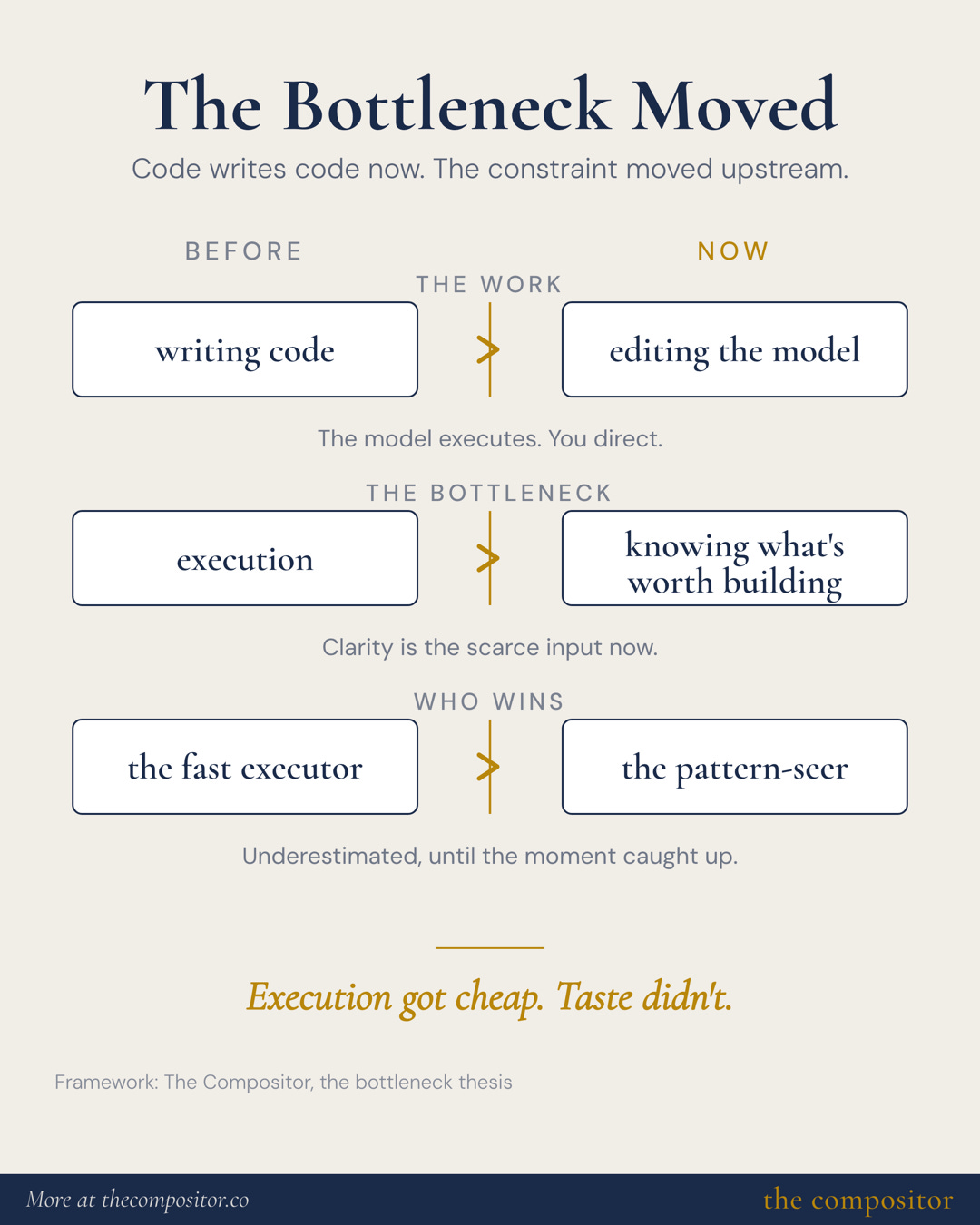
But here’s what’s actually happening. The bottleneck isn’t execution anymore. It’s clarity about what’s worth building.
At Anthropic, CEO Dario Amodei told the World Economic Forum in January: “I have engineers within Anthropic who say ‘I don’t write any code anymore. I just let the model write the code, I edit it.’” Their internal research describes engineers shifting roles — from code writers to managers of AI agents. The work that matters now isn’t syntax. It’s knowing which problems are actually worth solving. It’s taste.
This creates an opportunity for a specific group of people. Not the ones who climbed the traditional ladder. Not the ones with perfect resumes. The ones whose brains work differently — and who’ve been underestimated their whole lives because of it.
But for those who did make it through — who had just enough structure, just enough luck, just enough support to stay on some kind of trajectory — school was still a puzzle they couldn’t solve.
And they were the kids teachers didn’t know what to do with. Smart but bad at school. Never studied but got straight A’s in subjects that interested them. Teachers couldn’t explain it. Your peers couldn’t explain it. You couldn’t explain it.
You probably didn’t get the highest SAT scores. You might not have gone to a flagship state school — community college, mid-tier university, or you dropped out because the format made no sense and you couldn’t force yourself to care about GPA when you were bored. The executive function required to manage school felt like a personal failing, not a mismatch between your brain and the system.
So you ended up in places where your neurology actually worked. Creative roles. Design. Marketing. Agencies — which have a reputation for being full of ADHD folks because the work is varied, high-stimulus, and you can’t stay in one job for seven years without dying of boredom. Or you started your own thing. Your LinkedIn looks different from the Harvard-to-McKinsey-to-Google pipeline. It’s got range. Different industries. Short tenures mixed with deep obsession on specific projects. You succeeded in some, not all. Your resume doesn’t look like the perfect track.
And right now, you’re probably one of two places: either you’re in a product or engineering role at a tech company feeling like you have more capacity than your role uses, competing in a market that rewards speed over insight, or you’re running your own thing because working for someone else’s vision feels suffocating.
This is your moment to actually use your full capability.
So what now? If you’re the person this describes: stop waiting for permission to believe you’re capable. The evidence is structural now, not anecdotal. Your brain isn’t broken. The moment has caught up to how you think.
If you’re building something — whether that’s a company, a team, or a product — look for people with these patterns. Not because neurodiversity is trendy. Because they see what others miss. They synthesize complexity into clarity. They thrive when the problem is ambiguous and high-stakes, which is exactly when most people freeze. They’re in your industry right now, probably underutilized, probably feeling like they’re not living up to their potential. They might be the designer who’s been at the agency for six years. The product manager at a big tech company who feels caged by process. The founder running something solo because they couldn’t survive corporate structure. The person whose resume looks unconventional because they’ve been following insight instead of climbing a ladder.
Give them space to think.
Give them novel problems.
Give them autonomy over how the work gets done.
Watch what happens.
For everyone else: this isn’t about charity or optics. It’s about recognizing that the people around you who didn’t fit neatly into the shapes society offered might actually be exactly who we need right now.
Not despite how their brains work. Because of it.
The question isn’t whether these people exist.
They do.
The question is whether we’re actually going to let them do the work they’re built for.